Some mysteries don’t stay buried because they’re unsolvable — they stay buried because technology hasn’t caught up yet. And sometimes, it takes nearly half a century for the truth to rise to the surface.
The story of Cindy Marcell Blizzard, a Maryland teenager who ran away from her Monkton home in 1977, is one of those cases. It’s a story of loss, of distance, of decades-long silence — and finally, of identification thanks to the persistence of investigators and leaps in forensic science.
It’s also a story that reminds us how long families can wait for answers, and how thin the line is between a cold case and a solvable one when technology advances.
The Beginning: A Teenager Disappears
In the spring of 1977, Cindy Blizzard — just 15 years old — ran away from home in Maryland.
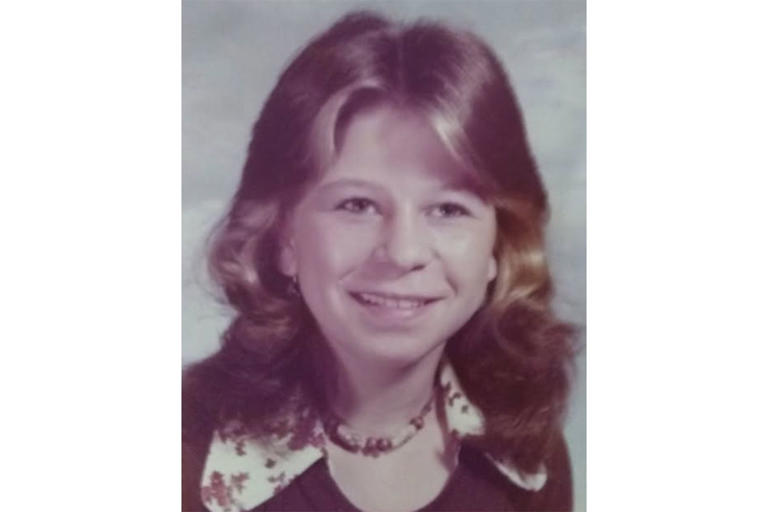
That same year, on December 29, 1977, skeletal remains and clothing were found in a wooded area in Wilson, North Carolina — roughly 320 miles away from where Cindy was last seen.
There were no immediate answers. No identification. No connection to a missing teenager from another state.
The medical examiner could only determine a few details:
- The remains belonged to a white female, likely between 16 and 23 years old.
- They had been in the wooded area for six months to two years.
The manner of death was listed as undetermined — but investigators believed foul play was likely.
And then the case froze in place.
The First Attempt at Science
For decades, investigators compared the remains to missing person files, dental records, and whatever leads they could find. Nothing matched.
In 2010, a state anthropologist tried again, submitting the victim’s teeth for DNA extraction and entering the profile into databases like CODIS and NamUs. Still, there was no hit. No link. No name.
The science simply wasn’t advanced enough yet.
So the case remained officially cold.
Unofficially, it was still waiting.
2024: The Technology Finally Catches Up
Nearly 50 years after Cindy disappeared — and almost as long since the remains were found — the North Carolina SBI’s Cold Case Investigative Team reopened the file in 2024.
Special Investigator Andy Murr took a fresh look. And this time, something was different.
He realized the remains qualified for advanced DNA testing, something impossible in 1977 and still experimental in 2010. The Office of the Chief Medical Examiner sent a bone sample to a forensic lab, where specialists extracted DNA and built an SNP (single nucleotide polymorphism) profile — a far more detailed genetic blueprint capable of identifying relatives even generations removed.
A genealogy service used that profile to trace family connections.
Finally, the silence broke.
The Name Behind the Case
Investigators confirmed the identity:
Cindy Marcell Blizzard
15 years old
Missing since 1977
Found 49 years later
Cindy’s journey — from Maryland to North Carolina, from disappearance to anonymity — never had a chance to be solved until technology made it possible.
Her family now knows where she ended up.
What they don’t know is what happened to her.
A Homicide Investigation Reignited
The manner of death is still officially undetermined, but investigators have made one thing clear:
They are treating Cindy’s death as a homicide.
The circumstances surrounding the discovery of her remains point toward foul play, and investigators believe someone out there knows more.
The Long Road to Closure
It took nearly half a century to identify Cindy Blizzard. For families of missing children, that kind of timeline is unimaginable — decades of birthdays missed, searches abandoned, hope flickering and returning in waves.
But cases like this prove something important:
Cold cases are never truly closed as long as science keeps evolving.
Every technological leap is another chance for a name, a story, a truth.
Investigators Need Help
Cindy’s story finally has an ending to its first chapter: identification.
But the final chapter — accountability — is still unwritten.
North Carolina SBI investigators are asking for the public’s help. Anyone with information about Cindy’s disappearance or death in 1977 is urged to contact:
- N.C. SBI Cold Case Tip Line: 919‑582‑TIPS
- Email: coldcases@ncsbi.gov
- Wilson County Sheriff’s Office: 252‑237‑2118
A Final Thought
In the end, Cindy Blizzard’s case is a reminder of something stark yet hopeful:
Time can bury evidence, but it can’t bury truth forever.
Technology has given Cindy her name back. Now investigators — and maybe someone reading this — can help give her justice.

