Some stories are so stark, so claustrophobic, that they force you to imagine the details even when you don’t want to. This is one of them: four children, confined to the cab of a semitruck since 2019. Four children whose childhoods existed in the space behind a steering wheel. Four children who lived in motion but never got to move.
It’s the kind of case that exposes not just neglect, but a pattern of isolation and control that no one saw—because for years, no one was looking.
The Arrest
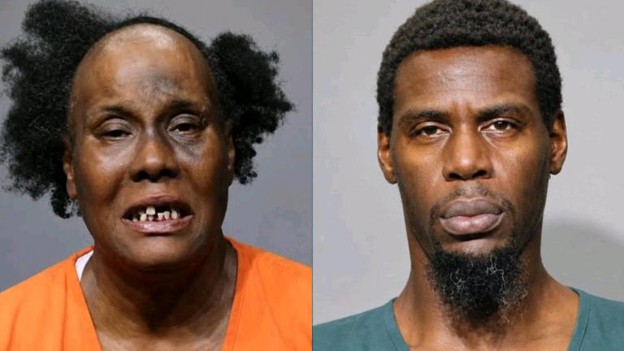
The arrests came only after a multi-jurisdictional investigation finally illuminated the reality inside that semitruck cab. Keisha Monique Epps, 51, was taken into custody on four counts of child neglect. Her co-defendant, 37-year-old Tamra Stewart, faces a charge of capital battery.
Bond conditions make it clear what the court believes: Epps must wear a GPS monitor, avoid minors, victims, witnesses, her co-defendant, firearms, drugs, and alcohol. Conditions meant for someone not just accused of neglect, but accused of prolonged endangerment.
But the bond sheet is only the surface layer. The deeper story lies in the years of confinement.
The Truck Cab: A Home Not Designed for Humans
Court documents paint a picture of life inside the semitruck—starting in December 2019. Epps worked for a trucking company running between Atlanta and Miami. For nearly five years, the cab wasn’t just where she worked, but where four children lived.
They shared a single bunk. That means four bodies curled into shapes small enough to fit. No room to stretch. No room to grow. Investigators described the children as walking with an unnatural gait, as though the years inside the truck had reshaped how their bodies understood movement.
They were rarely allowed out of the cab. Not for bathrooms. Not for air. Not even for the kind of wandering children are naturally wired to do.
Food was limited. Exercise was nonexistent. Their world was metal walls, engine rumble, and confinement.
The School That Wasn’t a School
For education, the children were reportedly given an app—one that had no accreditation, no oversight, no legitimacy. It was the appearance of learning without the structure, accountability, or reality of actual schooling.
In a system where truancy, homeschooling requirements, and social services are supposed to safeguard a child’s future, these four children slipped entirely through the cracks.
Injuries Without Care
Neglect is often cumulative. It builds. It compounds. And in this case, it left scars—literally.
Investigators documented an incident in which one of the children burned herself severely with cooked noodles. She received no medical treatment. The injury was never seen by a professional. The scar remains.
For most families, a burn sends you to the kitchen sink, the first-aid kit, the urgent care clinic. But these children weren’t living in a world with sinks or clinics. They were living in a cab.
The Abuse No One Stopped
While Epps drove, slept, or showered, Stewart allegedly abused the children. The children reported being punched in the head—multiple times. They said they told Epps. They said she didn’t believe them. And she continued leaving them alone with Stewart.
This pattern matters. Abuse isn’t just about the person inflicting the harm; it is about the person who enables the environment where that harm is possible.
Epps allegedly called the children derogatory names, blamed them for Stewart’s violence, and created a reality where their voices held no weight even in the moments they pleaded for protection.
A Detective’s First Look
When law enforcement first encountered the children, their gait reflected the years they spent unable to stand, walk, or stretch freely. Bodies adapt, even when the circumstances demand contortions. Their walk told the story before their words did.
The Broader Failure
It’s tempting to think of this case as a singular horror—a strange, extreme scenario that could only happen in the shadows. But shadows only exist where systems stop looking.
No school flagged the absence of enrollment.
No medical provider noticed missing checkups.
No welfare system stepped in during five years of confinement.
No community member reported concerns.
Child neglect on this scale isn’t spontaneous. It requires silence.
What Happens Now
Both Epps and Stewart remain in the Duval County Jail. The children’s next chapter—one that finally exists outside the cab—is not yet known.
But their story raises one of the hardest questions:
How many other children live in places adults never imagine checking?
Because tragedies like this don’t appear out of nowhere. They evolve, quietly, in the blind spots. And unless those blind spots shrink, cases like this will continue to surface—not as shocking anomalies, but as symptoms of systems that missed their chance to intervene.
The Psychology of Confinement and Control
Long-term confinement shapes behavior in ways most people never witness. For developing children, the consequences are even more severe. In this case, four children spent nearly five years in a space built for machinery and miles, not childhood. They slept curled tightly, walked with an unnatural gait, and learned to accommodate a world that never accommodated them.
Confinement at this scale often produces: • distorted motor development
• delayed emotional regulation
• hypervigilance or shutdown responses
• attachment disruption
• difficulty distinguishing normalcy from survival behavior
Children in prolonged restrictive environments may eventually stop trying to explore, stop asking for help, stop expecting care — not because the need disappears, but because the environment never meets it. For many, compliance becomes a coping mechanism.
In this case, the unnatural gait observed by detectives wasn’t just physical evidence; it was psychological evidence. It revealed adaptation to chronic restriction — bodies shaping themselves around deprivation.
The Neglect Mindset: A Psychological Breakdown
Neglect doesn’t usually begin as a single decision. It emerges from a chain of cognitive distortions: denial, rationalization, and the gradual erosion of empathy. For Epps, investigators’ descriptions suggest cognitive rationalization played a role — a belief that the children were “fine,” that the minimal schooling app was “education,” that confinement was “necessary” for logistics.
When caregivers begin reframing harm as necessity, every boundary becomes negotiable. The bunk becomes a bed. The cab becomes a home. An injury becomes an inconvenience, not a medical crisis.
And with rationalization comes detachment. Children become passengers, not dependents.
The Abuse Dynamics
Stewart’s alleged behavior fits a common pattern seen in confined-group settings with no oversight: an aggressor whose actions escalate because no external force intervenes. Abusers thrive in isolation. And isolation was the defining feature of the cab.
Psychologically, children in confined abusive environments often: • avoid reporting abuse due to fear of disbelief
• normalize violence when caregivers dismiss disclosures
• divide caregivers into “safe” and “unsafe,” even when both contribute to harm
• internalize blame when caregivers insist the abuse is their fault
This dynamic was evident here. When the children reportedly told Epps about the abuse, she didn’t believe them. That moment is critical: disbelief conditions silence.
Systemic Blind Spots
The systemic failures in this case are not accidental — they form a pattern seen in long-term neglect cases where families fall outside conventional oversight channels.
Failures included: • lack of school enrollment tracking
• absence of routine medical or dental checkups
• no welfare checks despite years on the road
• no scrutiny from employers regarding living conditions in the truck
• geographic transience limiting local oversight
Mobile lifestyles — including long-haul trucking — often place families outside the scope of traditional child welfare detection systems. Without a stable home address, school attendance, regular medical visits, or community ties, warning signs disappear into the interstate.
Child welfare systems rely heavily on visibility. These children had none.
Why No One Saw Them
Because the world they lived in wasn’t designed for children — and therefore never assumed children were inside it.
Semitrucks are transient spaces, constantly crossing jurisdictions. That mobility became a shield. Each city saw a truck; no city saw a family.
Neglect thrives in motion. It thrives where records don’t follow, neighbors don’t notice, and institutions don’t expect to find children.
The Long-Term Impact
Research on children exposed to chronic confinement and neglect predicts long-term challenges: • cognitive delays
• trauma-linked anxiety disorders
• physical developmental impairments
• difficulty trusting authority or caregivers
• impaired socialization
Healing requires not just care, but recalibration: teaching bodies, minds, and emotions how to exist in a world beyond the cab.
 amandasheppardauthor