WARNING: GRAPHIC CONTENT
Some crimes do not fade with time—they ferment. They settle into the collective memory like a bruise that never heals, growing darker at the edges each year that passes without answers.
In Philadelphia, one of those bruises belonged to a small, malnourished boy found in a discarded cardboard box more than six decades ago. For generations he was known only as America’s Unknown Child—a nameless victim whose suffering was etched into his body even after death.
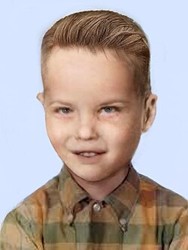
Only in 2022 did the world finally learn his name: Joseph Augustus Zarelli.
This is not just the story of a murder. It’s the story of how a child vanished into anonymity—and how science, persistence, and uncomfortable truths eventually pulled him back into the light.
A Discovery That Shook Philadelphia
On a cold February day in 1957, a cardboard box lay half‑hidden along a rural stretch of Susquehanna Road in Fox Chase. Inside was a small boy—naked, underweight, freshly groomed, and covered in bruises and surgical scarring. His haircut was so recent that loose clumps of hair clung to his skin. His fingernails had been carefully trimmed.
The combination of brutal injury and careful grooming told investigators something chilling:
someone had tried to erase him, and someone had tried to present him.
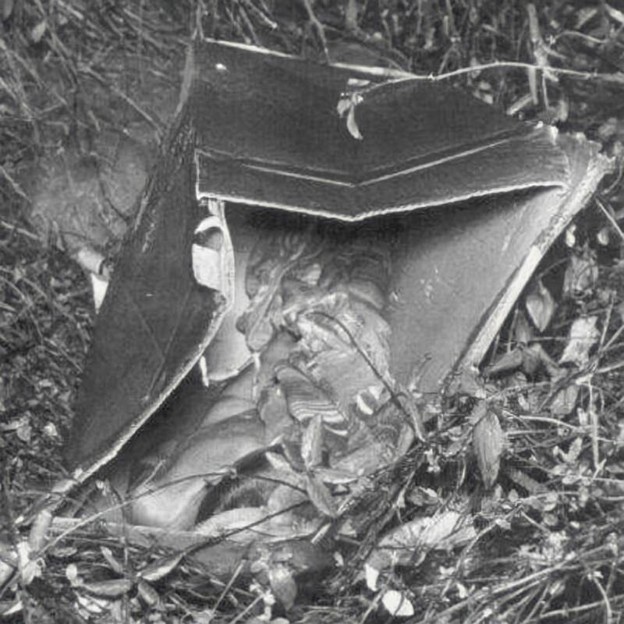
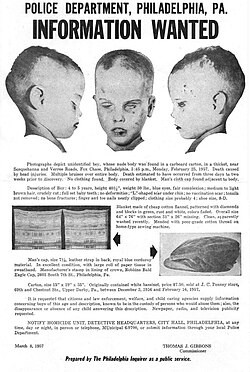
When detectives recovered his body, they believed identification would happen quickly. Flyers with his reconstructed likeness flooded Philadelphia by the hundreds of thousands. Police recruits combed the woods. Every possible clue—a corduroy cap, a scarf, a monogrammed handkerchief—was logged, analyzed, and discarded as dead ends.
Despite the scale of the hunt, no one stepped forward. No one recognized him. No one missed him loudly enough for authorities to hear.
Joseph Zarelli became a ghost boy—seen everywhere, belonging nowhere.
Decades of Theories, Dead Ends, and Desperation
In the absence of a name, theories rushed in to fill the void.
Some came from seasoned investigators; others surfaced from psychics, amateur sleuths, or witnesses with stories so disturbing they still reverberate today.
One investigator was led by a psychic to a foster home near the discovery site. He found objects eerily similar to those associated with the crime—and spun a theory around hidden pregnancies and concealed shame. But every child in the home was accounted for, and decades later the lead collapsed.
Another woman—known only as M—approached investigators in 2002 with a claim that both fascinated and unsettled them. She alleged that her mother had “obtained” a young boy years earlier, kept him in the basement, subjected him to abuse, and ultimately killed him in a violent rage after he became ill. Her story included details that aligned uncannily with autopsy findings: remnants of food, signs of bathing, scars.
Investigators found aspects of her background credible—her parents’ occupations, the layout of her childhood home, certain personal details. Yet other pieces of her testimony were impossible to verify. Her memories existed in a fog of trauma, inconsistencies, and decades‑old recollection.
Despite how compelling her claims seemed, they could not be substantiated. M’s story remains one of the most haunting threads in the tapestry of this case—neither fully debunked nor ever confirmed.
The Breakthrough: DNA Speaks When Humans Don’t
For years the boy lay beneath a headstone that simply read “America’s Unknown Child.” But science was quietly evolving behind the scenes.
His body was exhumed in 1998. Again in 2019. Each time, new DNA techniques extracted more information than the last.
And then came the shift that changed everything: investigative genetic genealogy.
It took one relative—one person uploading DNA to a public database—to open the door.
From that single match, genealogists constructed family trees, traced relationships, connected distant cousins, and ultimately reached the boy’s parents. The chain of evidence was reviewed, confirmed, and re‑confirmed through official records.
On December 8, 2022, authorities finally said the words that had been missing for 65 years:
The Boy in the Box is Joseph Augustus Zarelli.
Born January 13, 1953.
Four years old when he died.
A child who did not simply vanish—he was hidden.
What We Still Don’t Know
Identifying Joseph was monumental—but it didn’t end the story.
In many ways, it began a new one.
Authorities have not disclosed his parents’ identities publicly out of respect for living relatives, though both parents are now deceased. They revealed that Joseph lived in West Philadelphia and would have been seen by neighbors, relatives, or others during his short life.
Someone, somewhere, remembers him.
Investigators still do not know where Joseph lived day‑to‑day, who had custody of him, who inflicted the injuries, or why no one spoke up. The circumstances of his death—the timeline, the motives, the hands responsible—remain part of an active homicide investigation.
Even the scars on his small body—some surgical, some not—carry secrets that have yet to be fully interpreted.
Joseph Zarelli finally has a name.
The person who took his life still does not.
The Witness Called “M” — A Shadow That Remains
The most controversial piece of this case continues to be the testimony of M—an educated, accomplished woman who, late in life, told detectives that her childhood was a pipeline of abuse. Her story paints her parents as predators, her home as a site of prolonged torture, and Joseph as a captive who never escaped.
Some parts of her account aligned with known facts. Some fell apart under scrutiny. Some remain simply unverifiable.
What makes M’s story linger is its possibility.
If true, it suggests Joseph was not only murdered but held in secrecy for years by people living quiet, professional lives in an affluent suburb.
If false, it reflects the tragic complexities of trauma and memory.
Either way, her testimony casts a long, unsettling shadow over the timeline of Joseph’s existence.
A Child Finally Seen
On January 13, 2023—Joseph’s 70th birthday—a new memorial stone was revealed at Ivy Hill Cemetery. His name, once lost, is now carved permanently above the ground where he was reburied with care, honor, and community presence.
Visitors still leave toys. Flowers. Notes.
Philadelphia never truly forgot the boy in the box.
It simply didn’t know how to name its grief.
Now it can.
This Case Isn’t Over
Joseph’s name is a beginning, not an ending. The people responsible for his death may no longer be alive, or they may simply never have come forward. The truth may still be buried in old memories, private family histories, or the silent records of homes that once held secrets.
As investigators said:
“We have our suspicions.”
But suspicions are not justice.
If you follow my work—through Black Widows, through my upcoming book Angels of Death: The Hidden Crimes of Medical Killers, and through the ongoing cases I examine—you know that true crime is never just about the crime. It’s about the systems, the environments, and the individuals who allow violence to breed in silence.
Joseph’s life and death demand answers.
And even after 65 years, the pursuit continues.
 amandasheppardauthor